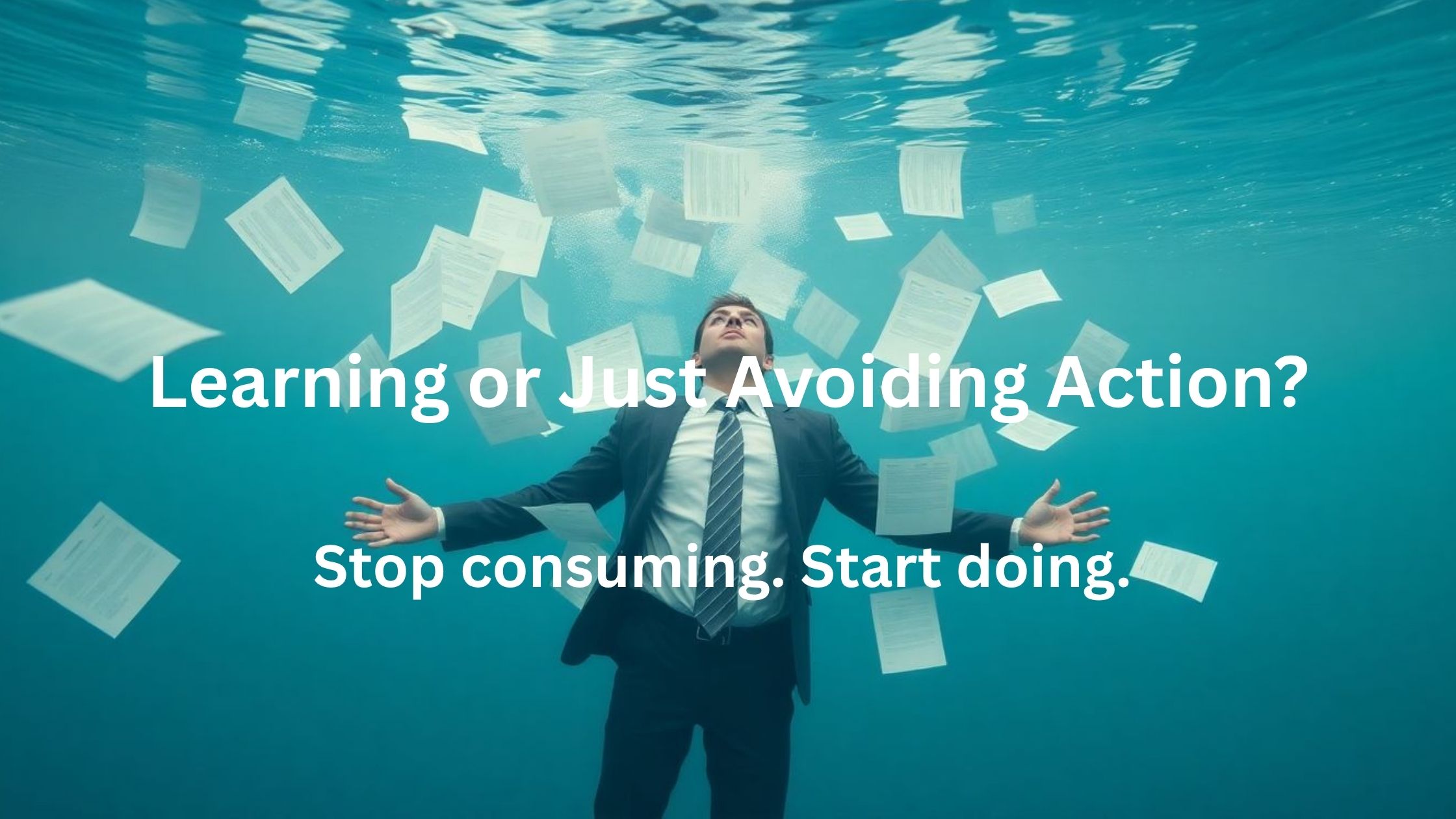
When I first started trying to build an online business, I thought the more I learned, the better my chances of succeeding.
So I learned. A lot.
I watched YouTube videos, downloaded free guides, attended webinars, read blogs and bought courses.
There was always something else I thought I needed to understand.
How to build a funnel.
How to grow an email list.
How to get traffic.
How to write better emails.
How to use the latest tool.
The strange thing was, I could spend an entire evening learning about online business and go to bed feeling as though I’d achieved something.
But when I looked at what I’d actually built, sometimes very little had changed.
I was learning.
But I wasn’t necessarily moving forward.
When Learning Feels Like Progress
Learning is important. There’s no question about that.
When you’re new to online business, there’s a lot you simply don’t know.
The problem starts when learning becomes a substitute for doing.
I fell into that trap more times than I’d like to admit.
If I wasn’t sure what to do next, I’d research it.
Then I’d find three different answers.
So I’d research those.
One person would recommend one approach. Someone else would tell me the exact opposite. Before long, the simple question I’d started with had turned into another evening of comparing strategies.
Instead of becoming clearer, I became more confused.
And there’s another reason learning can be so attractive.
It’s safer than doing.
Watching a video can’t fail.
Reading another guide can’t be rejected.
Researching how to write an email is much more comfortable than actually writing one and sending it.
You can stay incredibly busy without ever putting anything to the test.
More Information Doesn’t Always Create More Clarity
One of the biggest lessons I’ve learned is that more information doesn’t automatically give you a clearer answer.
Sometimes it does the opposite.
The internet gives us access to an extraordinary amount of useful information, but it also gives us thousands of different opinions about how an online business should be built.
Most of those opinions aren’t necessarily wrong.
They’re just answering different questions for different people at different stages.
That’s where I got into trouble.
I’d consume information because it sounded useful, not because it solved the problem I was working on at that moment.
I could be worrying about traffic before I had anything useful to send people to.
Thinking about advanced email automation before I’d built much of an email list.
Looking at another piece of software before I’d properly used the tools I already had.
Each subject was relevant to online business.
But that didn’t mean it was relevant right now.
Learn With a Purpose
These days, I think there’s a much simpler way to approach it.
Before learning something new, ask:
What am I trying to accomplish right now?
Then:
What do I actually need to learn to do that?
That changes the purpose of learning.
Instead of:
“I should learn more about email marketing.”
it becomes:
“I want to write my first welcome email. What do I need to know to write a useful one?”
Instead of:
“I need to understand SEO.”
it might become:
“I’m writing a blog post. What basic SEO do I need to understand before I publish it?”
The subject becomes smaller.
The goal becomes clearer.
And most importantly, there’s something to do when you’ve finished learning.
Learn It. Use It. Then Move On.
If I could give my earlier self one simple rule, it would be this:
Learn what you need. Use what you learn. Then learn the next thing.
Not:
Learn everything you possibly can before you start.
I’ve spent plenty of time trying to understand things I wasn’t ready to use.
And I’ve also made the opposite mistake—rushing into something without understanding enough about it.
Neither extreme is particularly helpful.
The aim isn’t to stop learning.
It’s to connect learning with action.
Learn enough to take the next sensible step.
Take it.
See what happens.
Then decide what you need to learn next.
That’s very different from endlessly consuming information and hoping that eventually you’ll feel ready.
You Probably Know More Than You Think
This is something beginners often overlook.
After months—or sometimes years—of courses, videos, blogs and webinars, lack of information may no longer be the biggest problem.
You may already know enough to take the next step.
Perhaps not perfectly.
Perhaps you’ll make mistakes.
But that’s where another kind of learning begins.
You learn by actually doing something.
Writing the article teaches you things that another ten videos about blogging won’t.
Sending the email teaches you something.
Putting up the page teaches you something.
Trying to attract your first visitors teaches you something.
At some point, information has to become action.
Otherwise, learning can become just another way of staying stuck.
One Question Before You Learn Something Else
The next time you’re about to watch another video, download another guide, join another webinar or buy another course, ask yourself:
What am I going to do differently after I’ve learned this?
If you have a clear answer, great.
Learn what you need and put it to use.
But if you can’t answer that question, perhaps you don’t need more information right now.
Perhaps it’s time to use some of what you already know.